The Vault: Part 5

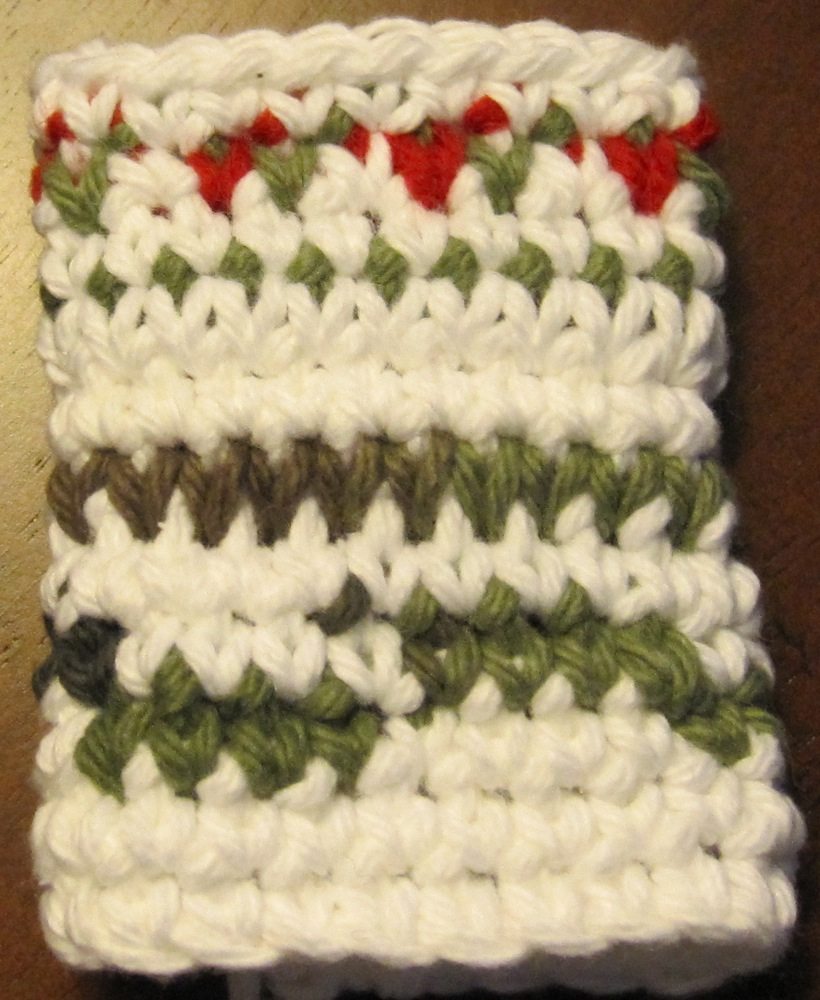
My fox experience led to playing around with color change, seeing what happens when you change color in some rotation. I had to play again to reconstruct what happened in the photo below, but it was fun to do.

old color experiments

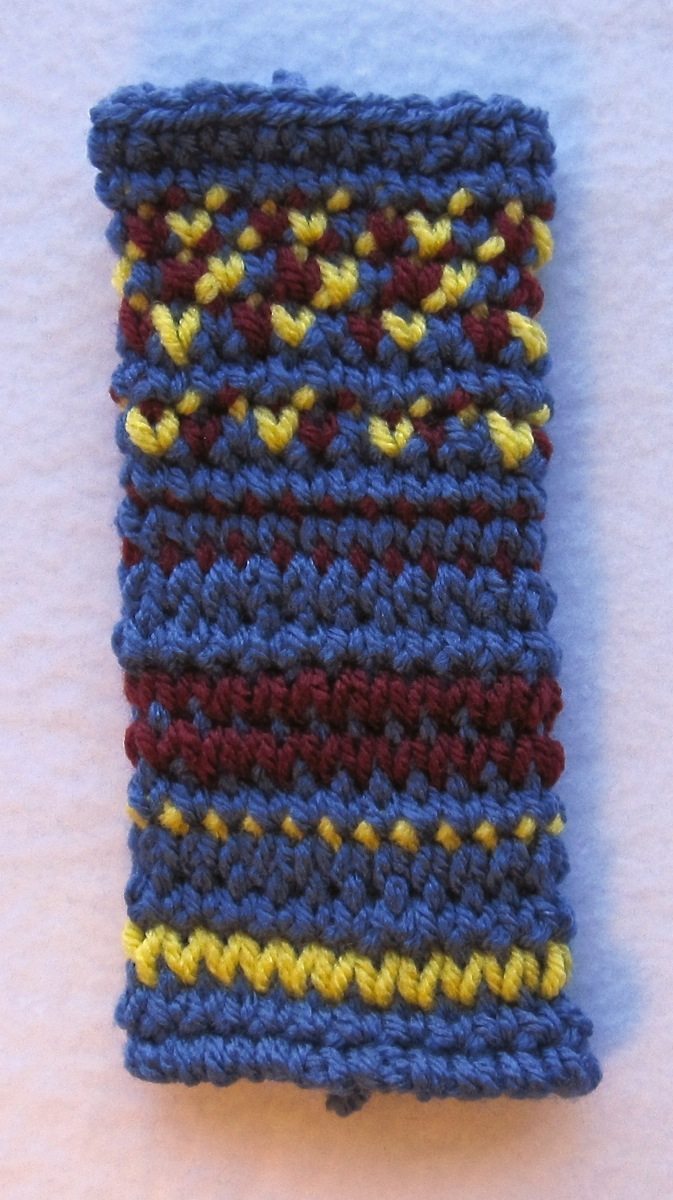
This is all in single crochet, of course, the center of my crochet universe. The picture above is of a piece rather unhelpfully made partly in variegated yarn; I tried to give more visual information when I recreated it. Working from the bottom up in the picture below, starting and ending with two rounds of single-color stitching and with a round of single-color in between each of the following, is a single round of alternating loops of each of two colors, another single round but with the position of the colors swapped, paired rounds of each of those situations, and finally a single and then three rounds of three colors in rotation, one loop in each at a time. In the single round of three-color work I pulled loops in the order blue, yellow, red. In the second I pulled blue, red, yellow; there are three rounds instead of two because when I started round 2 I realized that I was pulling a loop of red through a red stitch-top, and likewise for the other colors, so at the end of that round I inserted an additional loop of blue and made a round where the colors did not match.

new color experiments

This work is somewhat less elastic than crochet usually is, but not terribly so (you do have to make sure not to pull your yarn tight, as with any color work). If you like the look of duplicate stitch embroidery on knitting, this is probably the easiest way to get it in crochet – it’s not an exact match, but I’m not sure such a thing is possible, and you don’t have to do any embroidering!

To be continued…

Last-minute scarf

I promised a scarf to a friend for her daughter, and sat down to start it. To my surprise, in less than an hour and 45 minutes the crocheting was done and I just had to add fringe!

last minute scarf

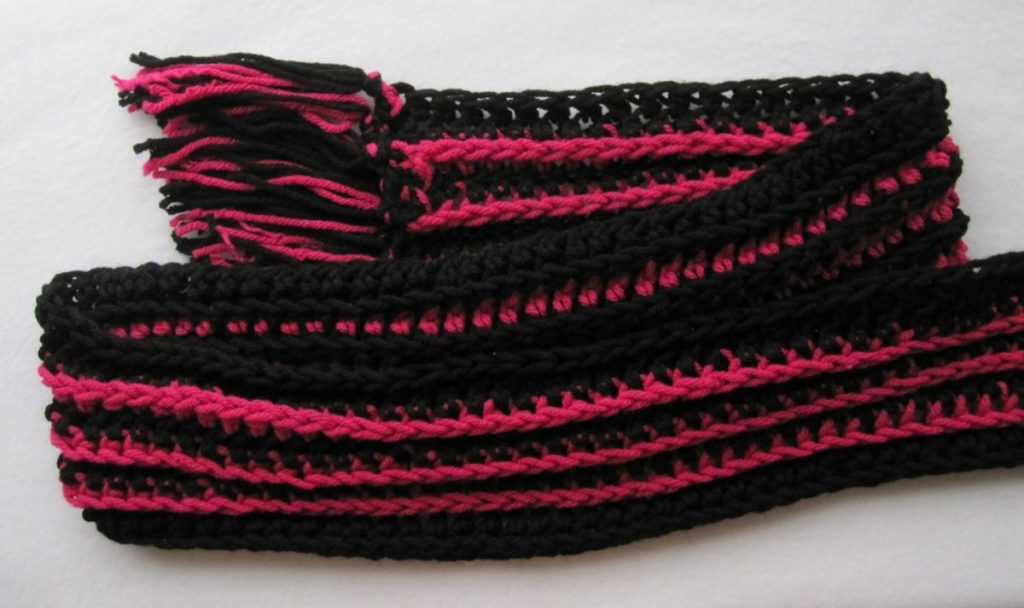
There it is with the fringe. This is a scarf in half double crochet, each row stitched in the bottom loop of the “faux teardrop” on the back of the previous row. I got the idea from Jenn Ozkan, but clearly from the pictures I used a larger hook for the yarn than she did: K/10.5 (6.5mm) for Red Heart With Love, a plush worsted at the thickest end of the weight class. I wanted the scarf to be soft and smooshy.

I started with a row of foundation hdc that was about 54″ long (though you could certainly use a starting chain instead), and stitched 9 rows total:
2 black
pink, black, pink, black, pink
2 black
The scarf is about 5″ wide. A skein of RH With Love is 7 oz/370 yds (198 g/338 m), and I used about three-quarters of a skein total: just over 3 oz (160 yds; 85 g/146 m) of black and just under 1.5 oz (80 yds; 43 g/73 m) of pink. Over half an ounce of black and about a quarter ounce of pink went to the fringe.

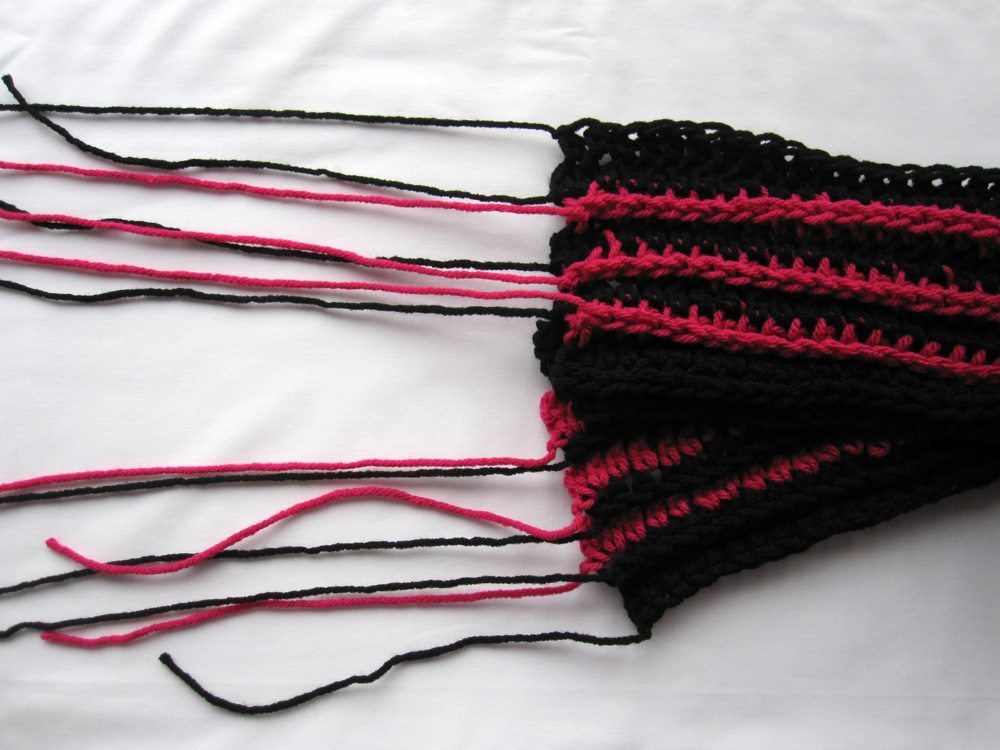
It wasn’t really practical to carry my yarn between stripes, because I was always starting colors at the opposite end of the scarf than I had finished them previously. Instead, at the beginning and end of each length of yarn I left a long tail to incorporate into the fringe. If you want to try out foundation half double crochet for the first time this isn’t a bad choice of project for it. There’s a great tutorial for foundation sc on futuregirl’s blog, and the modifications for hdc are minimal: still a ch-2 to start, a yarn wrap before each hook insertion, and pulling through 3 loops on the hook where in sc you’d pull through 2. Fuller instructions at the bottom of the post, but meanwhile fringe!

fringecloseup

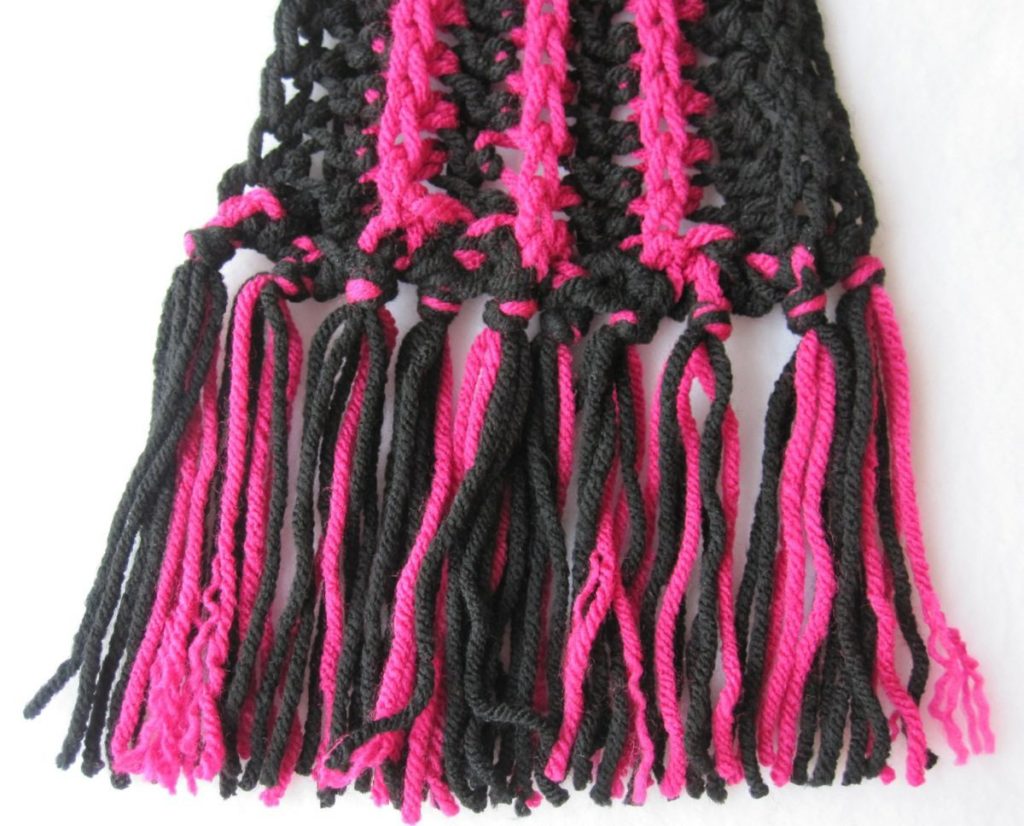
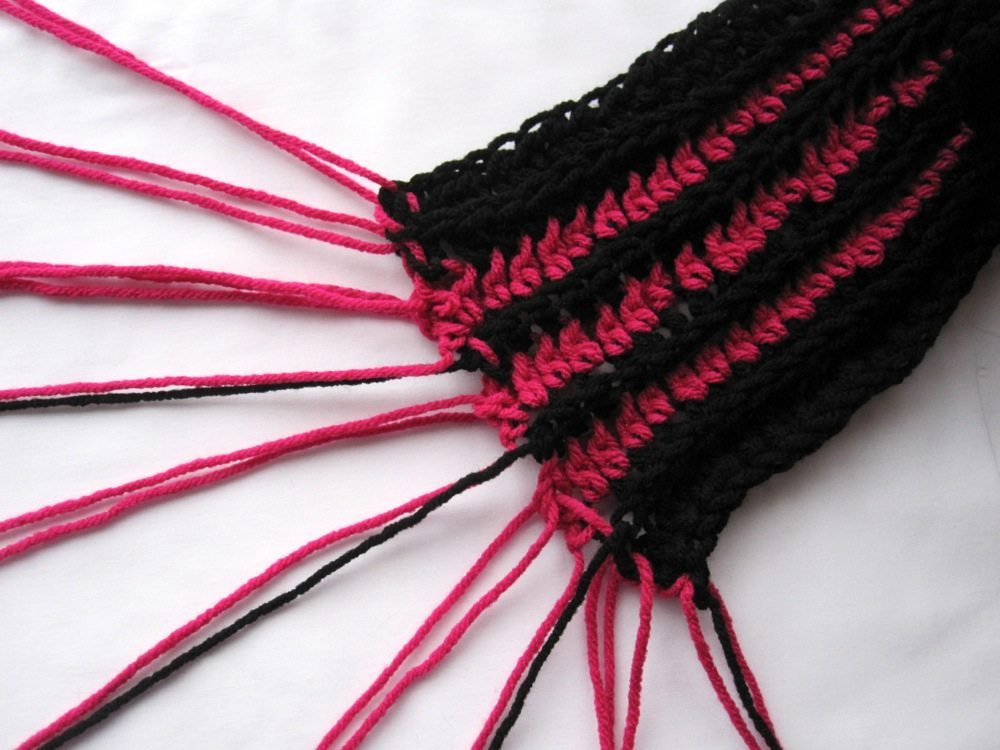
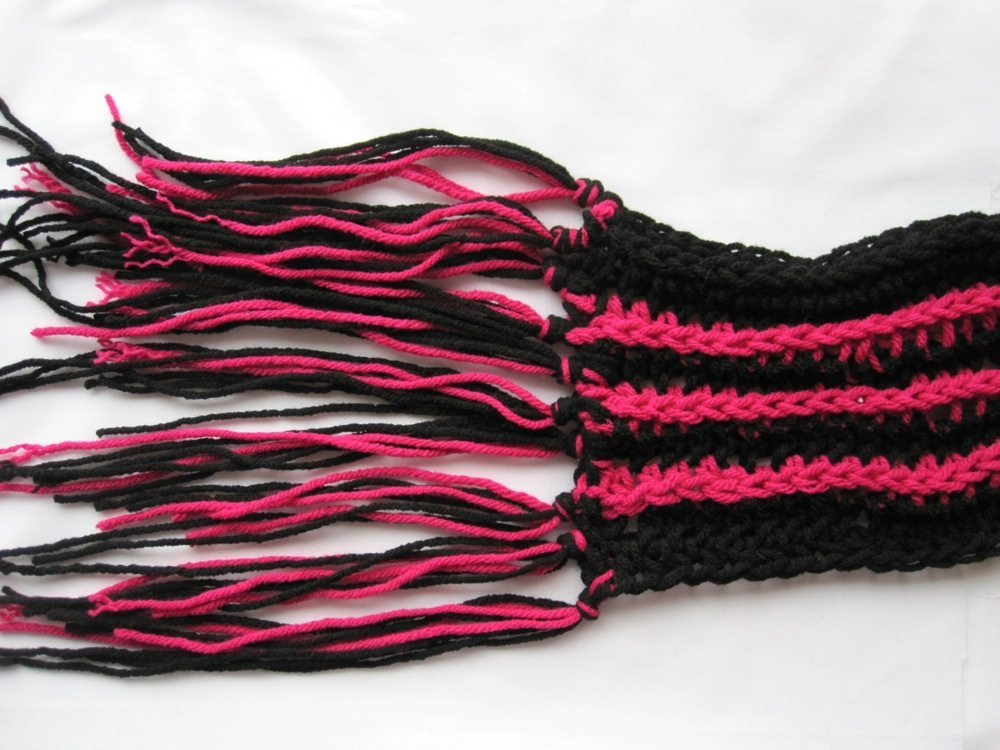
The recipient of the scarf has three younger siblings, the youngest of whom is still a baby. I wanted to put fringe on the scarf in such a way that picking it out would be laborious. My solution was to put the ends of any given length of yarn in two different tassels. I should probably tell you adding fringe took about as long as the crocheting, but if you did it a more simple way (either feeding a bundle of yarn through and tying it in an overhand knot, or attaching a bundle of yarn with a lark’s head knot) it would be a lot quicker. I cut two-foot lengths of yarn, 11 pink and 21 black for each side. Most, if not all, of the strands are in tassels no more than 3 apart. In between I tried to corkscrew them around – and sometimes not having messy strands meant getting the tassel strands around the outside of the lengths stretching between tassels. I did all the pink first so the black would cover it over a bit between tassels. The pictures below show the loose ends from crocheting, most of the pink strands woven in, and the fringe finished but not yet trimmed. I have a note to myself that indicates I believed I took pictures when 4 tassels had been knotted and the rest were awaiting the rest of the black yarn, but apparently that was only a hallucination.

unfringed scarf partly fringed scarf uncut fringe

Most of the 10 tassels on each end have 7 strands of yarn, but one has 8 since there was an odd number of strands left from crocheting. They are 2 pink and 5 black, 3 pink and 4 black, and one 3 pink and 5 black. I tried to have more pink on the outside tassels and less on the inside ones. I trimmed the fringe by eye, and the reason it looks shaggy is that I did so before washing the scarf. The scarf is fully machine washable and dryable (in acrylic yarn, and in a mesh bag to avoid snags) but the fringe will get split ends, so don’t trim until afterward (and hand wash/line dry if that will bother you).


Foundation Half Double Crochet:
1. Chain 2; yarn over, insert hook into first chain and pull up a loop. Pull it up a little higher than you would normally.
2. Yarn over and pull through first loop on hook (essentially, chain 1).
3. Yarn over and pull through all 3 loops on hook. [One foundation half double crochet, fhdc, made.]
4. Yarn over, insert hook into chain made in step 2 and pull up a loop. Again, a little higher than you would normally.

Repeat from step 2 as many times as desired, but stop after step 3 of the last hdc. Basically, step 1/4 creates a location to stitch into, and steps 2 and 3 are a half double crochet made in that spot. My note about pulling the loop in step 1/4 up higher than you would normally is because foundation stitches are supposed to be true to width, but if I do not make sure to pull that loop up tall I get a tight edge (a fhdc strip that curls downward) exactly as I do if I use a starting chain without doing something about my natural chain tension.

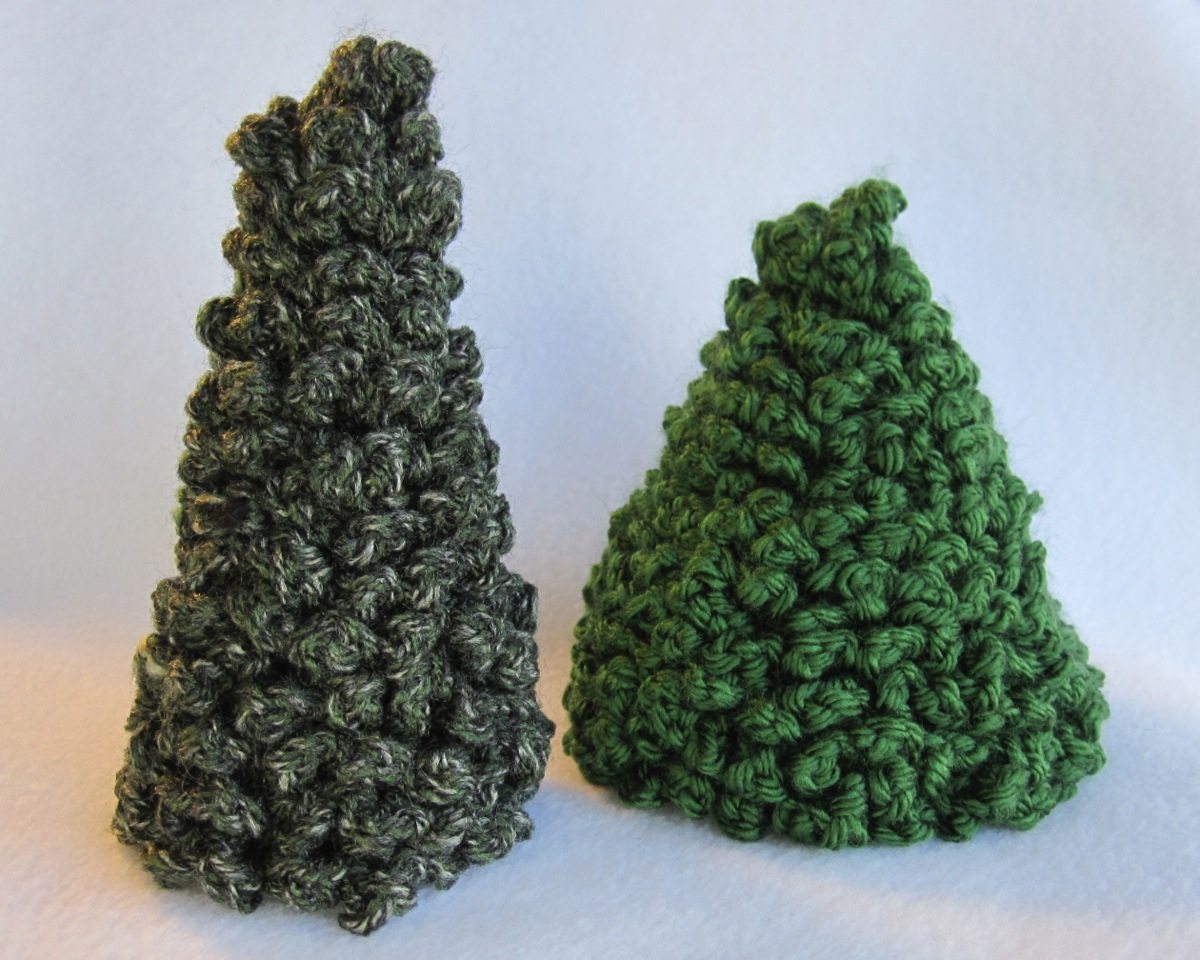
Crocheting a pine tree

tabletop trees

A stylized pine tree is basically a cone, with something passing for branches around the outside. I wrote about cones earlier this week and more information can be found there, but the important recap is: To make a cone in single crochet, start with a 4 or 5 stitches in a magic ring (you can even go as low as 3, but be careful to work right-side-out as early as possible, because a tight turn with back-loop-only fabric can create big gaps in the stitching), and single crochet in a spiral. Work in back loops only and add the same number of stitches to each round (on average, at least). Try to shift them around so the increases aren’t all on top of each other.

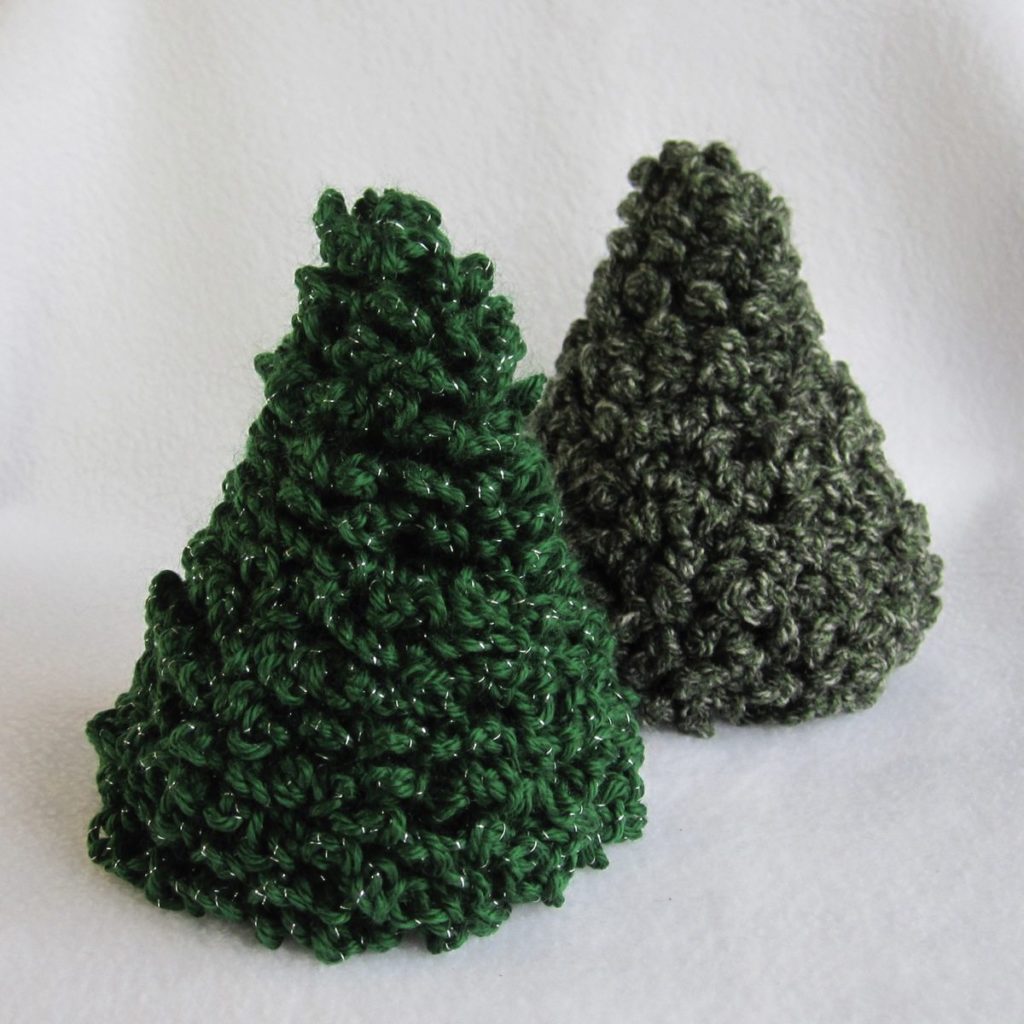
The narrower tree below was made by starting with 4 stitches and increasing by 1 stitch per round usually, but by 2 stitches every fourth round or so, for a total of 14 rounds. The wider tree started with 5 stitches in a magic ring, and then 2 or 3 stitches were added each round, alternately. It has only 13 full rounds. Both trees, however, also have a partial round for straightness. Spiral crochet loses ground with each round, so by the time you get to 14 rounds you’re well behind where you began, and adding some stitches can be necessary to get the tree to stand up straight. Do that by eye; start with about a third of the stitches around, but be prepared to add or subtract stitches a few times. It doesn’t need to be perfect, though, partially because not all trees are totally straight and partially because back-loop-only fabric can be molded to shape enough to accommodate small imperfections.
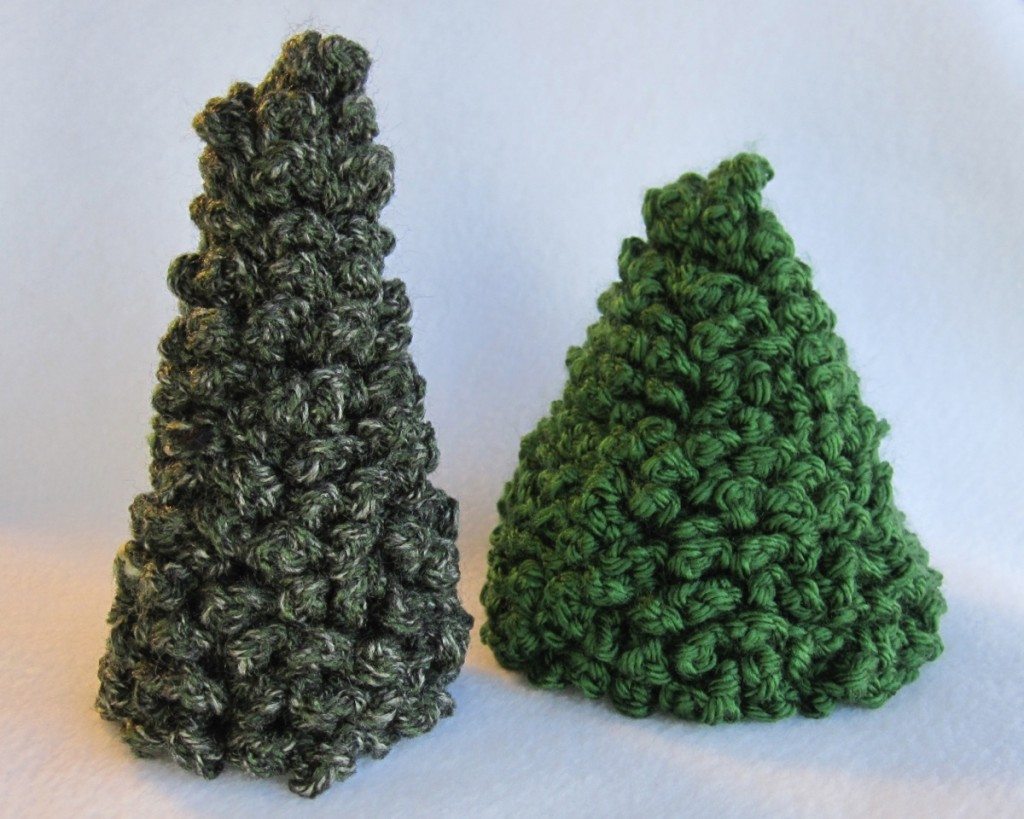
tree comparison

Cone bases (also discussed earlier this week): Start with 7 sc in a magic ring and add 7 to each round: 2sc around, then *2sc, sc* around, then *2sc, sc 2* around, continuing or stopping short as needed to make a disk of the right diameter to fill the space in the bottom of the cone. If correct diameter and matching number of stitches are in conflict, favor correct diameter.

Stuffing: You don’t want to overstuff, because back-loop-only fabric can stretch out and expose the stuffing through holes. However, stuff enough to make sure the tree has body. This is more important the taller your tree is relative to its diameter. The tall, thin blue tree in the previous post was originally understuffed, and after I put the branches on, the tip of it didn’t want to stay upright. I had to wedge more stuffing in through the fabric, which was kind of laborious.

Attaching the base: Essentially, sc around, making each stitch through the back loop of a cone stitch and both loops of a base stitch. I have found that often the base has fewer stitches around than the cone opening, though, and so some cone stitches will either have to be skipped or crocheted to the same base stitch as the previous cone stitch was. I have found that skipping stitches can tuck the bottom of the cone inward a bit, whereas crocheting two cone stitches to the same base stitch preserves the slant of the sides.

Branches: Starting with a new length of yarn, place slip knot on hook. Insert hook into unused loop of cone stitch closest to magic ring (point of cone), so your hook points down the tree (insert from point toward base). [If you crochet left-handed, point your hook the same direction, but begin at the base of the tree/opening of the cone instead of the tip.] Slip stitch to join yarn. Chain 4 and sc in same st as sl st. *Ch 4, sc in next lp* all the way around and around your tree. I like to replace the last sc with a sl st for smoothness. Nicely, if you accidentally skip a loop or double up, or are one chain short or long, it will just add to the natural look of the tree.

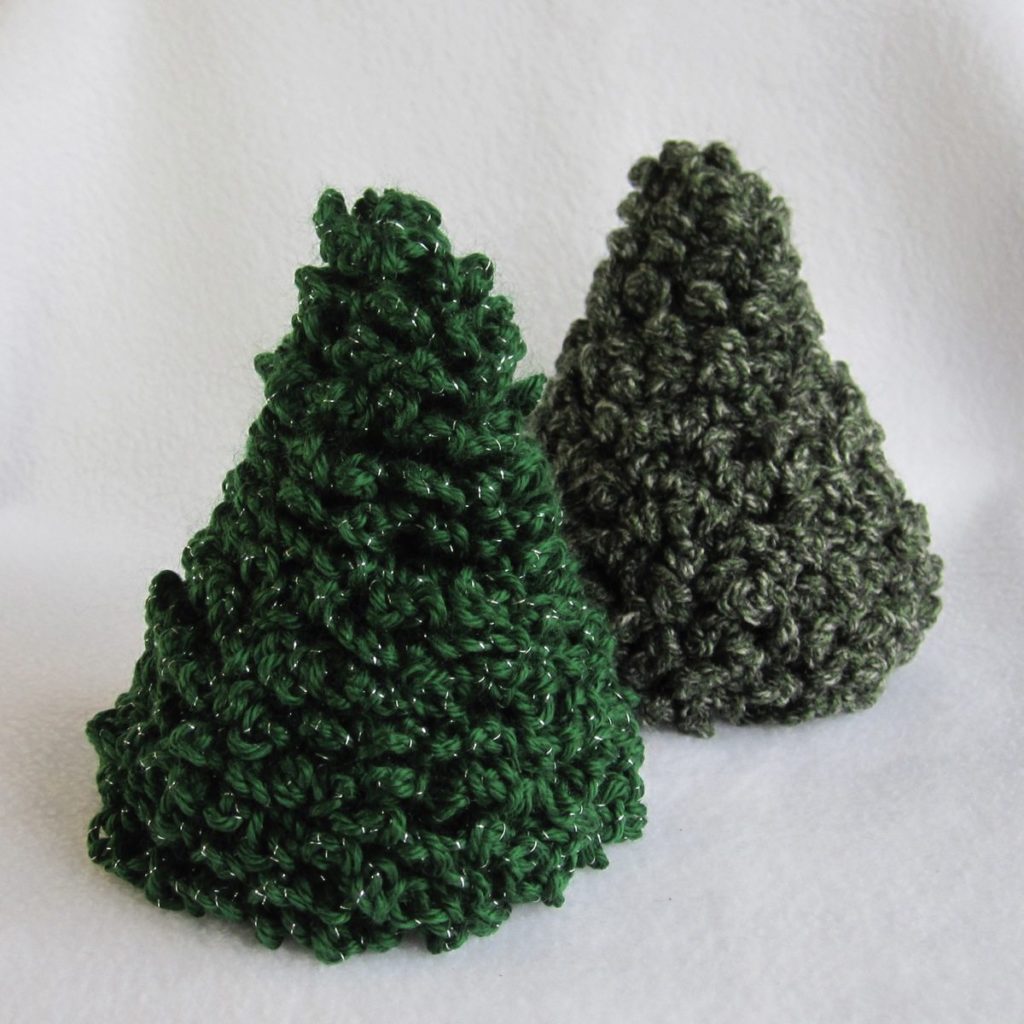
Designing your own: If you want to make a less straight-sided tree, keep in mind that whatever shaping you give the cone will be muted by the branches, so exaggerate it. The trees in the top photo are from my Tabletop Tree pattern; you would not guess they’d have the natural shape they do from the “unbranched” form. Those trees also illustrate something about design: the tree with the sparkly branches is made on a base of yarn that is thicker than the sparkly yarn, and the non-sparkly tree is the same yarn all the way through. The sparkly yarn was also very twisty, which I think contributed, but you can see how much smoother and more solid the non-sparkly tree is, whereas the sparkly one is rougher and shaggier.

If you’d like a different tree, here’s a hollow one made bottom-up with loop stitch, and here’s a stylized one made from three triangles stitched flat.


Overview post Making the tree
Blue, silver, and white decorations Red and gold decorations