Archive for May, 2011

Creativity challenge

It has come to my attention (via Iron Craft) that June holds the 30 Days of Creativity challenge, where you are to create something every day and submit it to the challenge. I won’t be participating; daily is just too much and I will have uncertain internet access at the end of the month. However, I thoroughly approve of the idea and wanted to pass it on!


Silver tie event

Remember this?

silver and velvet, ooh la la

Burly Hot-Pants has been with me or one of my former roommates since my senior year of college. I have no idea what sort of action figure he is, except it is not one of the major brands. I bought him at Wal-Mart, I think, and he became our mascot. We had photo shoots like “Burly Storms the Capitol!” (of Virginia) and “Burly in the Lost World!” (after Cha Cha brought home a bucket of plastic dinosaurs). We immediately gave him dark roots and tattoos. I don’t remember when we cut his pants off into short shorts, which eventually died and had to be replaced with new short shorts (those, I made in summer 2005). Originally he hung from the wire shelf in our fridge, a Cha Cha innovation, with a gun in his free hand. The guns disappeared long ago, leaving him only his boots and ammo belt. Near the end of senior year I bought him some Barbie accessories, though the only one that survives is a pearl necklace.

For Nickel’s wedding he acquired a silver Sharpie bow tie, and the necklace became a bracelet or anklet. That may have been when we gave him lipstick and nail polish, though we may also have done that earlier. Alas, the lipstick bled all over his mouth.

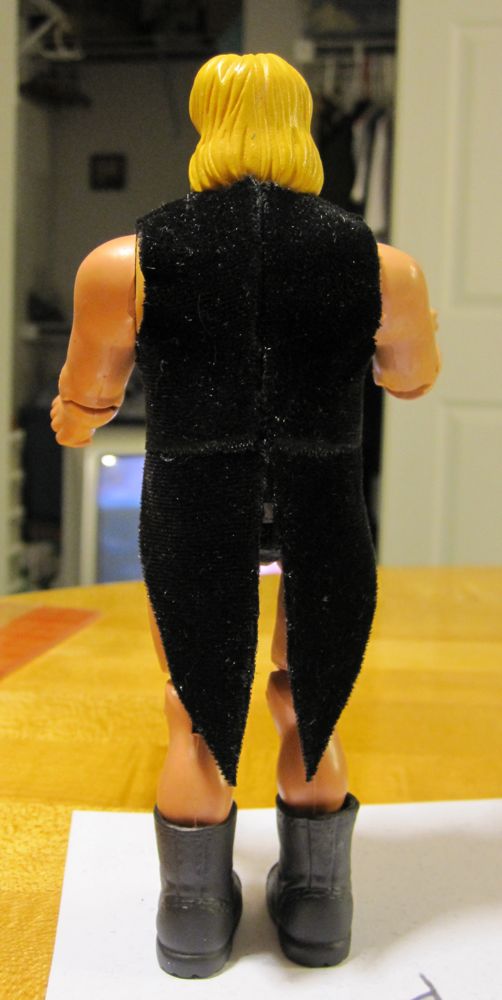
Naturally, he needed some new accoutrement for Dana’s wedding. What would be more natural than a Chippendales-style tuxedo jacket and cummerbund? He ditched his brown hot pants altogether in favor of his black plastic codpiece, but kept the boots and ammo belt (you never know what situations may arise at a wedding).

As BHP’s personal tailor and photographer, I present to you: Silver Tie Burly.
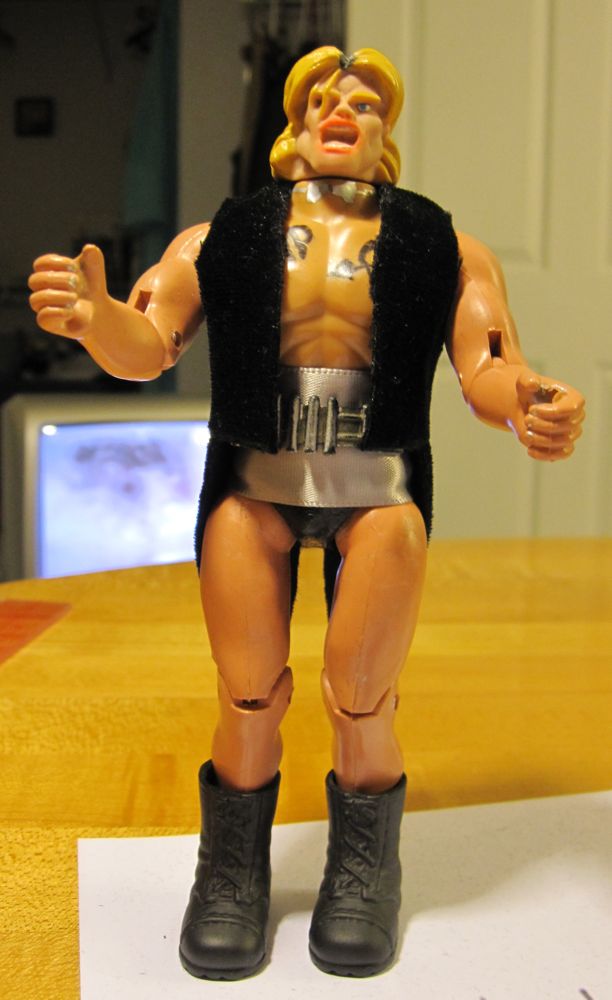
tux from front tux from back
You may be able to see in the back that I was watching Quest for the Mighty Sword, the greatest movie ever made.

As tough as he is, Burly has a softer side.
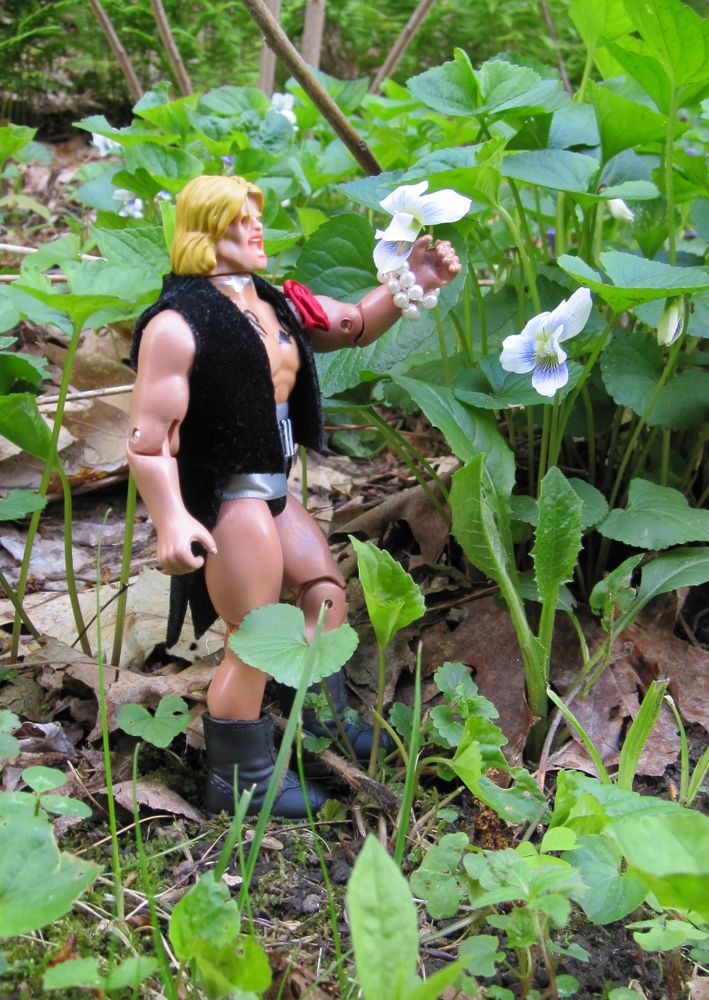
Burly's softer side

As you can probably tell, the cummerbund in the sneak peek picture was not the final cummerbund; I ended up just taking a length of ribbon and Stitch Witchery-ing velcro on each end.

Construction notes: I started by cutting a straight line across a strip of velvet and lining the bottom up with the top of BHP’s codpiece and the inside with the center of his chest or back, and gradually cutting the front and back pieces to shape. I used fusible interfacing both to stabilize the velvet and in place of sewing the seams (so it is far from the sturdiest item I’ve ever made). After cutting four pieces, to which tails would be attached, I realized it would be better to make two pieces that went around under his arms on each side and only had to be ironed together at the shoulder and center back. I also realized the heavier of the two interfacings I’d gotten to try (both Pellon, but one a lightweight standard-style interfacing and the other a sheer tricot) was the only one that worked – the tricot had too much stretch, which would be desirable in other settings but not when using it like tape. So I cut new pieces from wider velvet and used my tailor’s ham to aid in ironing (I could have used a smaller one! Perhaps I’ll make one). For the tails, I attached a strip of velvet to one side of the back hem, cut it to a nice shape, put another piece against it wrong sides together and cut it to match, and then ironed it on. I decided not to attempt a collar; I rather like the military-vest look of the front as it is, but admittedly the omission had more to do with thinking it would be difficult.
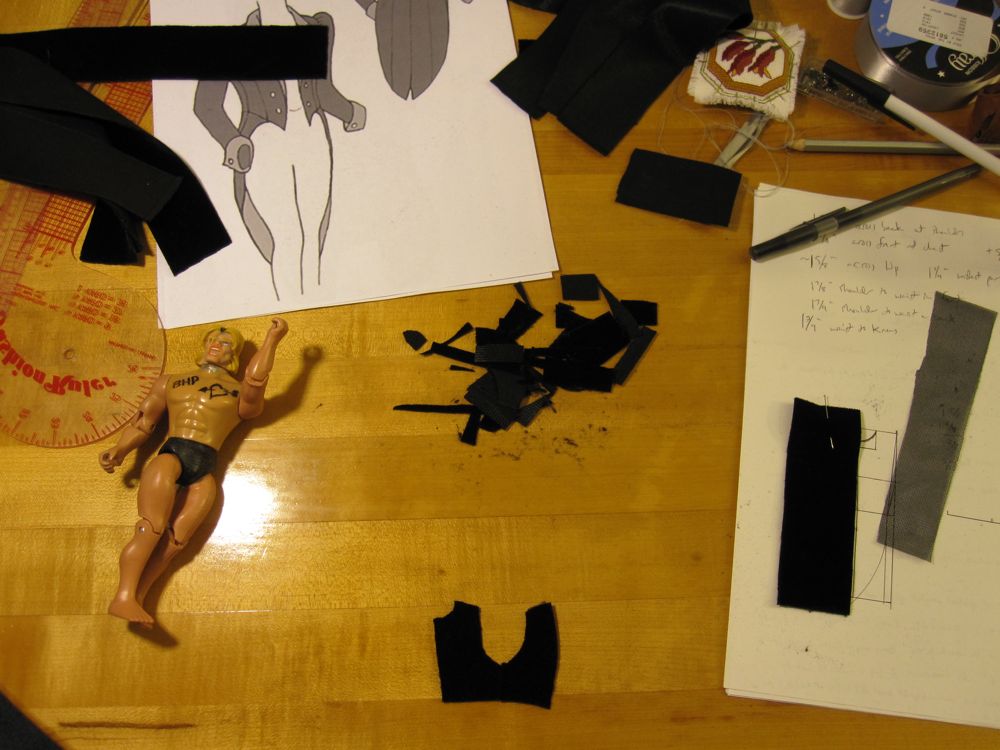
detritus

In the picture you can also see my primary inspiration.
 

Pinstripes

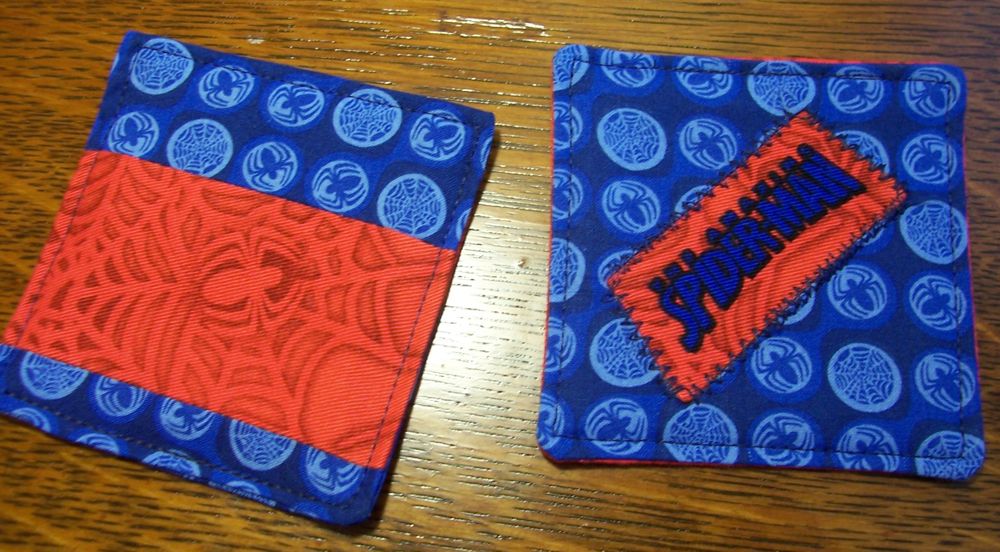
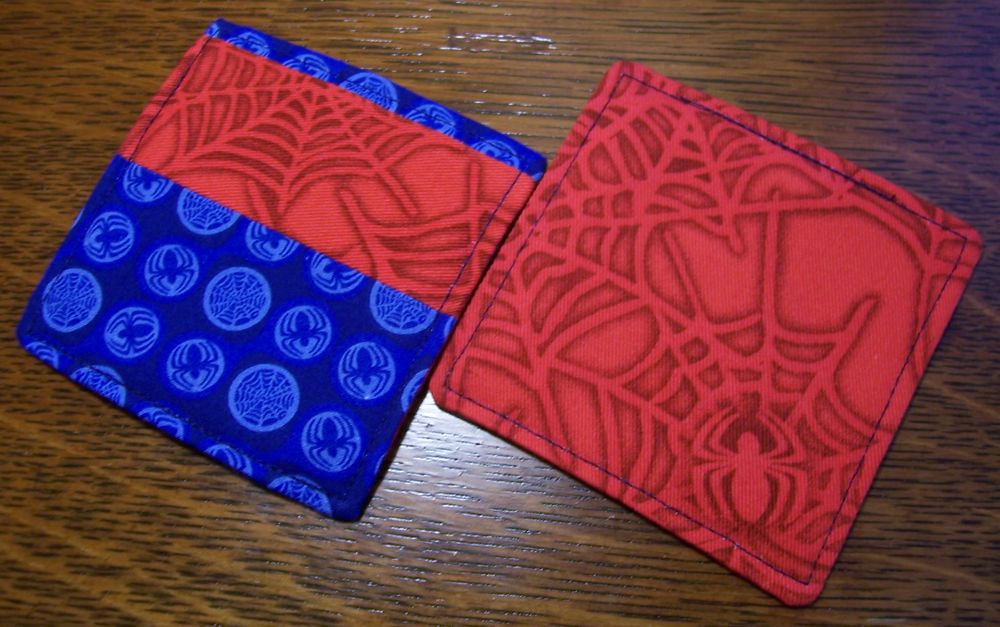
One of my college roommates is getting married on Saturday, and she and (especially) her fiance are big Yankees fans. I had thought of making them fabric coasters already, and in fact the Spider-Man coasters are for them (she used to shoot us with webbing in the dorm: “fffshhh! you can’t move for an hour!”). I got more ambitious, though, and added Yankees coasters to the list.

Edit: It has come to my attention that my ex-roommate is actually a Mets fan, and all the Yankees-related activities and decor I have seen have been her selflessly giving to her beloved. I hope she likes the Spider-Man coasters.

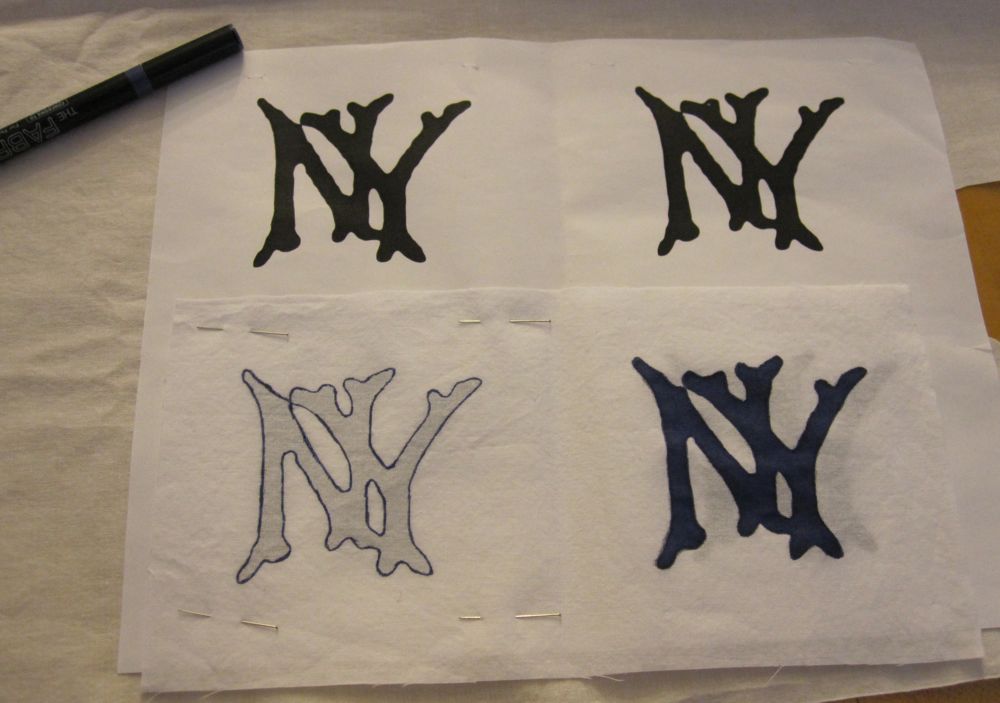
Navy blue fabric markers are hard to find. I thought I would have to go with acrylic paint, but finally found some at Create For Less, where I was glad to see the purchase multiple was just 1. A Yankees logo was easier to find; I decided on an old one because it was more interesting.

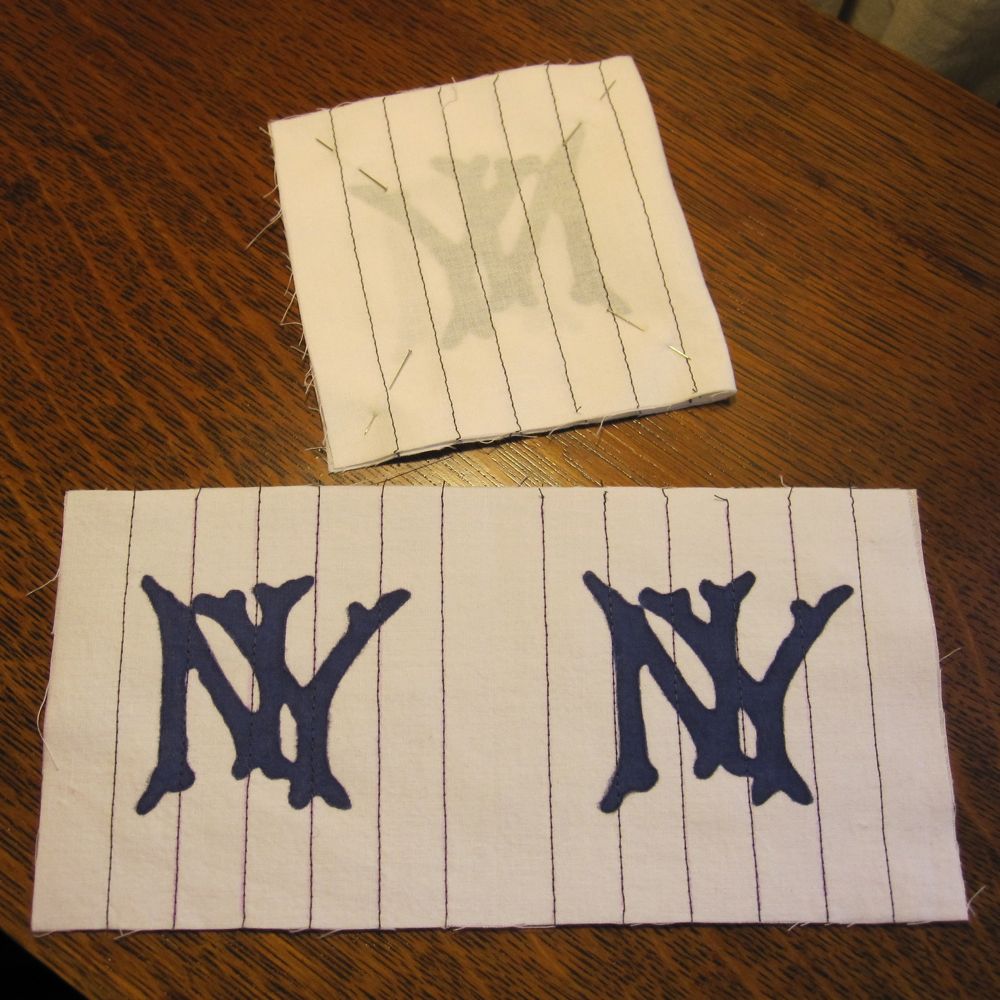
I acquired the logo before I was sure what I would do with it, so I printed it out 4-up at a reasonable coaster size. After my marker acquisition I traced the design onto strips of fabric that were two coasters big. At this point I hadn’t decided whether to make two coasters or four.

tracing the logo

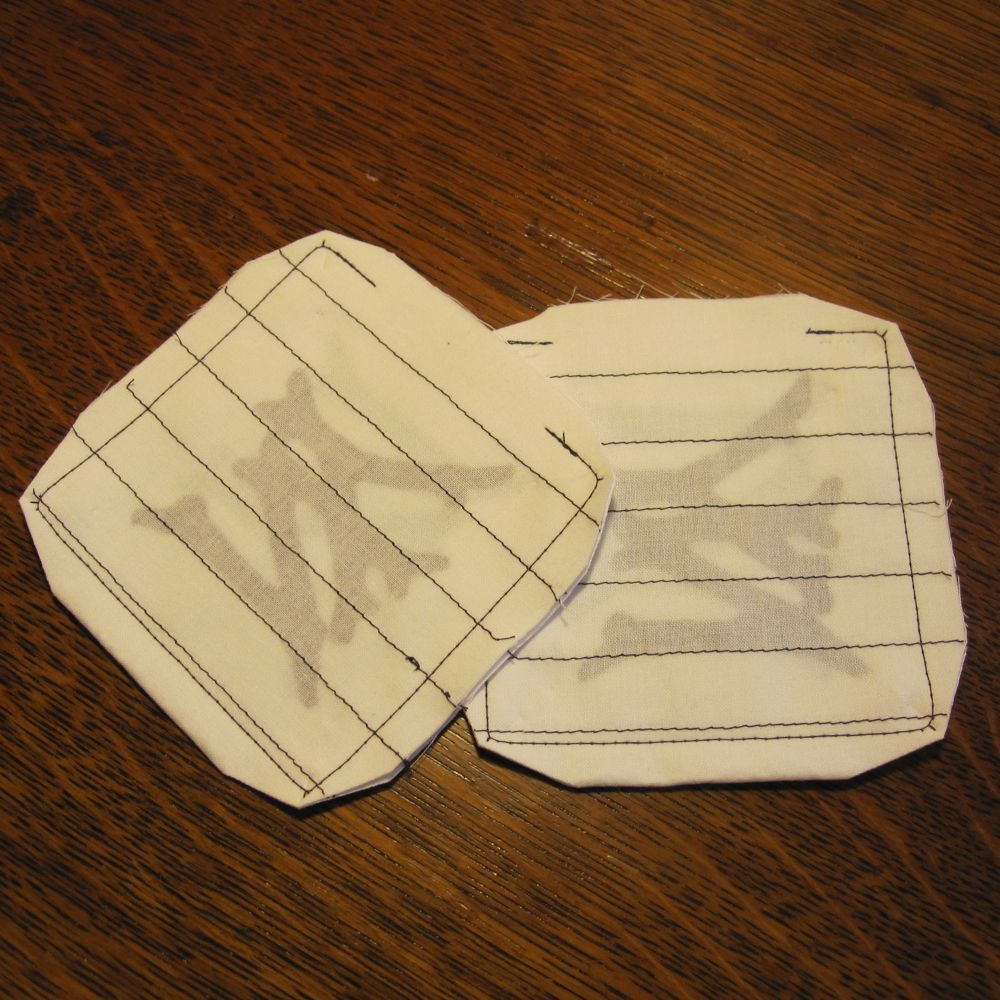
After pondering the fact that I already had two Spider-Man coasters for them, and four of “ordinary” fabric, I thought a total of eight, four themed and four not, made more sense than a total of six, all themed but not half-and-half. After heat-setting the marker, I ironed on interfacing and sewed pinstripes. If I’d paid attention I would have lined the pinstripes up to mesh with the edge-stitching better (read: at all), but they turned out okay. Here they are ready to sew and ready to turn:

pinstripes inside-out

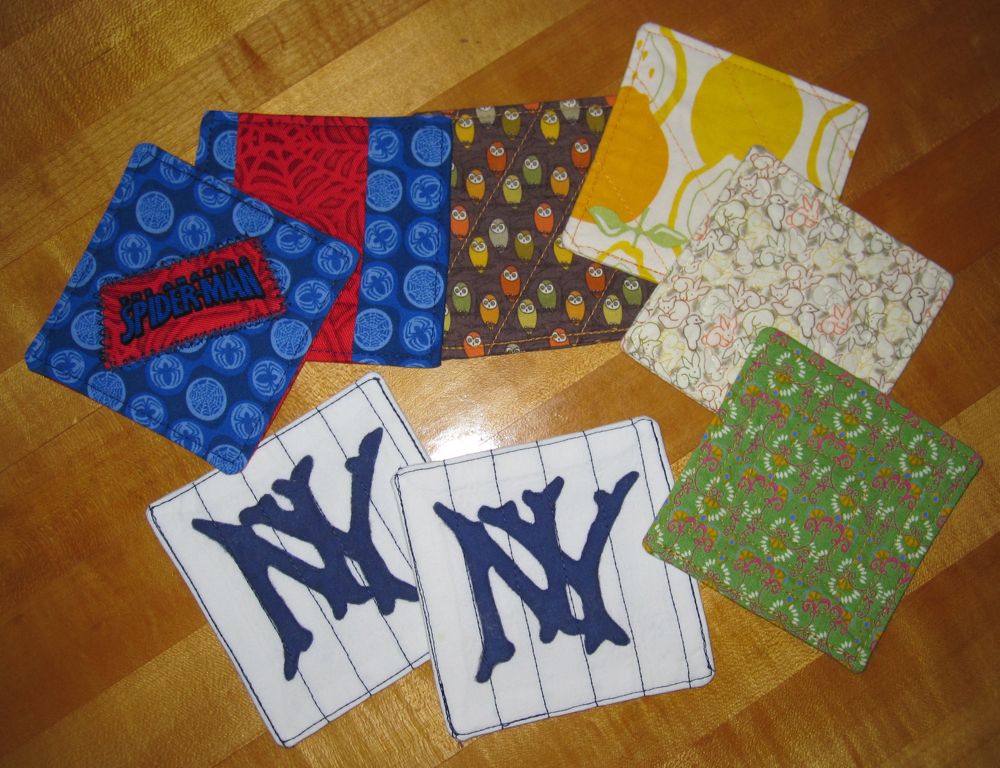
After a trip through the laundry and a press for neatness, they were ready to wrap! Here’s the whole family.

the whole group


Fabric coaster tutorial

A friend had a half-dozen or so thin fabric coasters lying around his apartment. He had bought them on Etsy and wished for more. They absorb condensation, cannot damage or be damaged by laptops and books laid on them, and aren’t thick enough to make such objects sit at an angle.

I have subsequently made a lot of these coasters, in various styles. They are extremely easy and utterly customizable. Whatever size square you want, add an inch in each direction to allow a half-inch seam allowance: a 5″x5″ fabric square will give you a 4″x4″ coaster, which is about the right size (the “originals” were 11cm square, which is about 4 1/3″).

Per coaster:
two 5″x5″ squares cotton fabric (matching or non-matching)
two 5″x5″ squares lightweight interfacing (fusible if you like)

Attach one piece of interfacing to the wrong side of each piece of cotton, by ironing on or basting with a long stitch and a 3/8″ seam allowance. “Quilt” each side individually if desired, stitching with a standard length stitch in some pattern you like: diagonal stripes, straight stripes, spiral, concentric squares or circles, freehand, cross-hatch. You may also quilt after putting the sides together. Pin the right sides of the cotton together and stitch with a 1/2″ seam allowance, leaving the middle of one edge open (but stitch all corners). Trim the seam allowance at the corners and turn right-side-out, working the corners to a proper point, and iron, with the fabric at the open edge folded inside. If you have an adjustable needle, move it to the right, and topstitch the coaster with the edge of the fabric lined up with the right edge of the presser foot. I usually start at the far end of the open edge and finish at the near end, so it is stitched across twice.

Some examples:

Spiderman coasters, front and back:

spiderman fabric coasters

spiderman fabric coasters

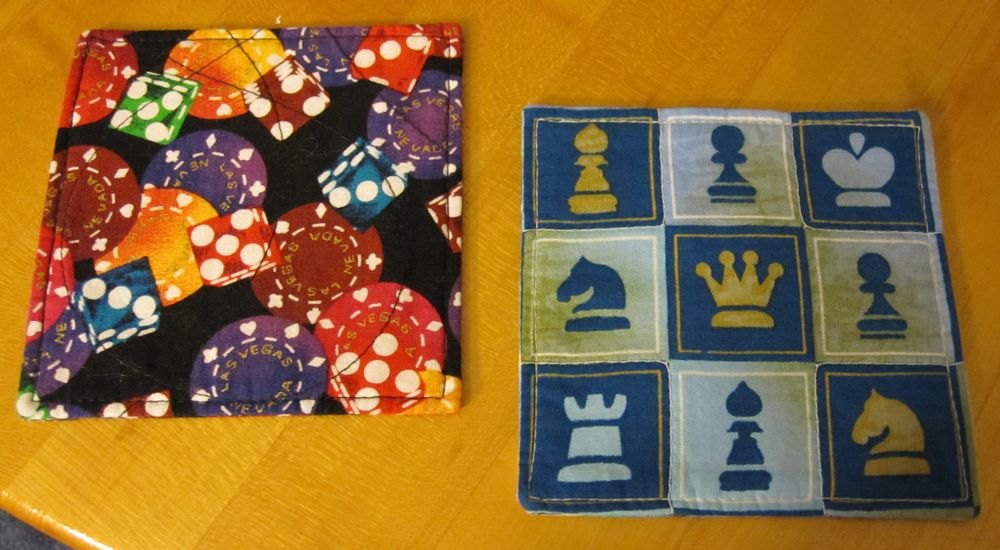
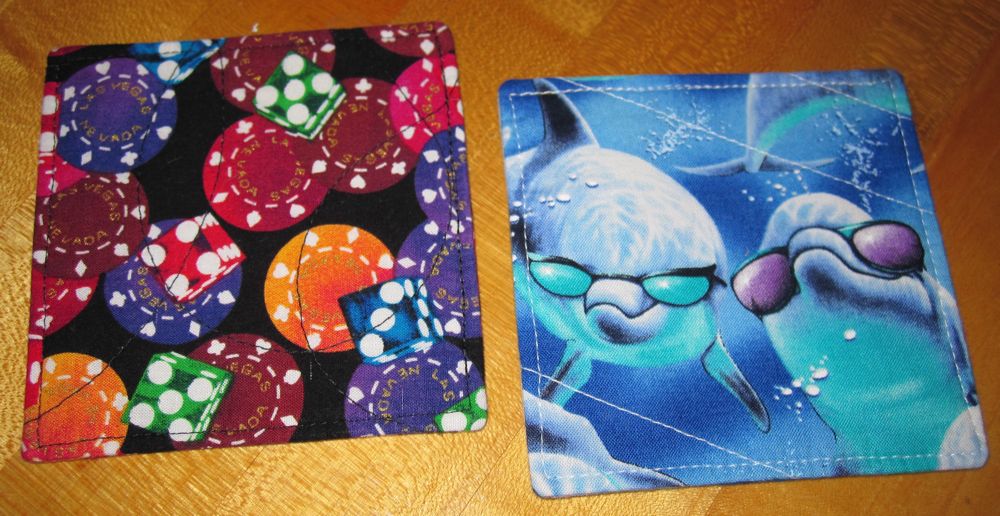
Inexplicable calico coasters, front and back:

vegas and chess fabric coasters

vegas

I’ve more recently found a blog post on cocktail napkins, which are basically the same as these except without interfacing or quilting, and with rickrack trim. Good ideas get around!


Hooks on parade

I crochet primarily in a recliner in my living room, with a small end table next to me and a lamp on each side. There’s not a lot of room, and the floor around the chair is covered with yarn, patterns, and notebooks. A rectangular tin that originally held fancy soap sits open on the end table, the body filled with reserved and leftover embroidery floss, the lid with current materials – including hooks. The steel ones disappear inside, and the aluminum ones stick out at one end. All of them catch on things and go missing periodically.

When I first learned how to knit, several years ago, I made needle and hook cases out of wool and calico. I still think they’re among the most attractive functional objects I’ve sewn:

cases, closed cases, open

However, they leave a little to be desired when it comes to accessibility. I quit knitting because it always felt like a chore, but the hook case has stuck around (and will continue to indefinitely, for travel purposes). If I ever pick up Afghan/Tunisian crochet the needle case will be useful for those hooks.

More recently I crocheted a lemon and stuffed it firmly with yarn ends to use as a pincushion.

lemon pincushion

Unfortunately, blunt needles have quite a time with it, and even the sharp pins can’t be inserted just any which way.

Then I found the Tower of Babel. This is the answer to my dreams: a long tapered strip, rolled into a tiered cylinder. Between the tiers you can insert hooks, needles, pins, even scissors, storing them visibly and at hand with a very small footprint. Certainly I still expect the current hook(s) to be lying around on the end table, but my most commonly-used hooks (E, F, and the 2.75mm steel) can live there. I made it in a day. As a bonus, I was able to use some wonderful cotton yarn whose colors haven’t worked for amigurumi.

tower, pre-rolling Tower of Babel


Success!

Tomorrow is my birthday, so I am taking a moment to reflect on projects that went just right. I’m generally happy with my work, but every once in a while the planets align and the result is better than I hoped.

In my early twenties I had a pair of jeans I loved, except that they were just a little too short. I added some length in the form of orange wire-edged ribbon, a beloved article from my stash, and miraculously, it worked! Even a professor who didn’t typically comment on such things said he liked them.

They are with me no more, though for the lovely reason that they are now too big, so I do not have a picture and must turn to more recent successes.

I adore brocade. It’s so rich! And so difficult to use for anything. However, I wanted a purse to go with a brown dress, and had brown and gold brocade at hand. My grandmother’s button box was in the closet and the two came together to make a perfect envelope clutch:

brown and gold brocade clutch purse

It is fully lined with an inner pocket. This picture shows the true look of the fabric better, too.

brown and gold brocade clutch purse

Perfect projects need not be self-designed, though that is a bonus. I wanted a hobo bag to take to Germany, and McCall’s M4400, in brocade again, came out exactly as I desired:

hobo bag

I didn’t technically have enough fabric to make the bag, so I had to piece the straps. In fact, though it does not show here, I pieced the lining as well. The depths of the bag are lined with a straw-colored calico because I didn’t have enough green; this actually is a bonus because it is easier to find things against a lighter background. In the close-ups you can also see the decorative topstitching I did (by machine!). The top seam of the strap didn’t stitch together so neatly, so I added a loop around to cover it up.

hobo bag piecing hobo bag strap

What projects, fabric or otherwise, have you had come out just right?


Yipig Yipig

April’s Amigurumi Army theme was “let’s pig out!” I had been wanting to try Kristie’s Kids’ pig pattern for a while, so that gave me the excuse to make it a priority.

At first, the pig was a little pink egg with ears:

egg pig

Then I found another skein of matching embroidery floss and made the legs.

front view side view

Finally, I put that pig to work.

sweatshop labor

Long ago, I began crocheting a Sesame Street yip yip alien, as explained by wikiHow. I made one false start well before the new year and according to my Ravelry records I started a second one on February 20th of this year. I altered the pattern a fair bit – I was skeptical of it when it said to chain 2.5 to 3 inches in order to make a loop an inch in diameter, an endeavor that requires over 3 inches of chain; but really I changed it so the decreases for the “head” were in the middle instead of at the edges. I was hoping that would make the mouth a better shape, though I am unsure of the quality of the results. My version is also a fair bit bigger than the pattern’s. Finally, I did long chains slip-stitched into loops around the base instead of the individual chains lark’s-head-knotted in pairs onto the base.

Instead of making the straw-piece eyes recommended by wikiHow I made – well, a bunch of eyes that are now in my “to use as stuffing” bin. I settled on: with black, start a magic ring, make one full sc and begin a second. For the final loop of that second sc change to white, and then make four more sc in the magic ring in white. Pull the ring tight. Continuing in white, still, continue around the circle making 4 more sc in back loops only. Tie the loose ends of the black and white yarn securely to the end of the black yarn still connected to the skein, and cut all three close to the knot. With the remaining white strand, make two invisible decreases, but use the back loops instead of the front loops. Slip stitch if desired, cut yarn leaving a long tail, and sew to close off back end of eyeball. Put loose end through side of eye for sewing to head.

I don’t think I can recommend that method.

Without further ado, though:

front view side view


Pi pillows

Recently I was asked by a student to participate in a Pi(e) celebration, giving the mathematical side. I decided to make Pi Prizes to give out for trivia such as where the first zero is in the decimal expansion of pi, the best fractional approximation for pi, mnemonic devices for the digits of pi, etc. I intended to crochet an amigurumi pi or three, but quickly realized that would take far too long.

Instead, I typed a boldface pi in the largest font size LaTeX makes, blew it up to maximum magnification in the pdf viewer, screenshot it, used iPhoto to print it out as an 8×10, drew a half-inch margin around it and used that as a pattern. When I sewed I actually only used a 3/8″ seam allowance, and if I were to make more I would probably adjust the pattern so the pi is not so spindly. I would also leave the top as the opening for turning and stuffing, even though stitching it closed there would be more visible – the first one I made I left the inseam of the left leg open, and getting the stuffing into the right leg was very difficult. In the latter two I left the top of the inseams and the bit of crossbar connecting them open, and the closed-up corners are not as neat as they could be.

Pi in the Sky and Cherry Pi:

plush pi in cloud and cherry fabric

Lemon Meringue Pi and my original crochet pi:

plush pi in lemon fabric and crochet pi

The fabric was all from my stash, including the cheesecloth meringue puffs. Pumpkin, apple, and pizza pi are other obvious choices, and I’ve thought about finding a lime-printed fabric and extending the crossbar of the pi to the right with a trefoil-shaped end to make key lime pi. Moon pi would be adorable. There are apparently several kinds of velvet pi. I may be missing other easy ones, but it seems to get abstract fast – chicken pot pi? Mud pi? Mincemeat pi? Humble pi? Cow pi?

I’m just glad I didn’t got through with my original plan of crocheting pi from furry yarn.


First Friday

Fun, nonsense, and coming attractions.

I hope you have an art gallery you can go to for a First Friday reception – now!

If not, well, you can look at some cool color-choosing webpages. Color Collective and design seeds take images and pull the component colors out of them. Color Collective is mostly paintings and photos of people, and design seeds is mostly still life, animals, and locations, though both cross over into the other’s terrain. Creature Comforts’ “color crush” category takes a palette and finds multiple objects that fit that color scheme: food, clothing, and household objects, primarily. In all cases you can see how the colors work together in “real life” and use them to inspire your own color selections.

These are from Wild Olive, whose embroidery basics series contained a color choice lesson with those links. She also curates her own Lovely Colors pinboard for wonderful combinations. Hat tip to my Iron Craft pal Kat for leading me to feeling stitchy and thence to Wild Olive.

In other news, I am excited for a spring project I have in the works… it involves destroyingpuncturing plastic bottlecaps (and a few metal wine bottle screw tops – I knew I saved them for a reason). Good clean fun! Hint: it is actually dirty fun.

my workbench

There’s also a sooper seekrit wedding gift in progress, which will hopefully be finished soon but not published until Memorial Day, after the wedding.

materials

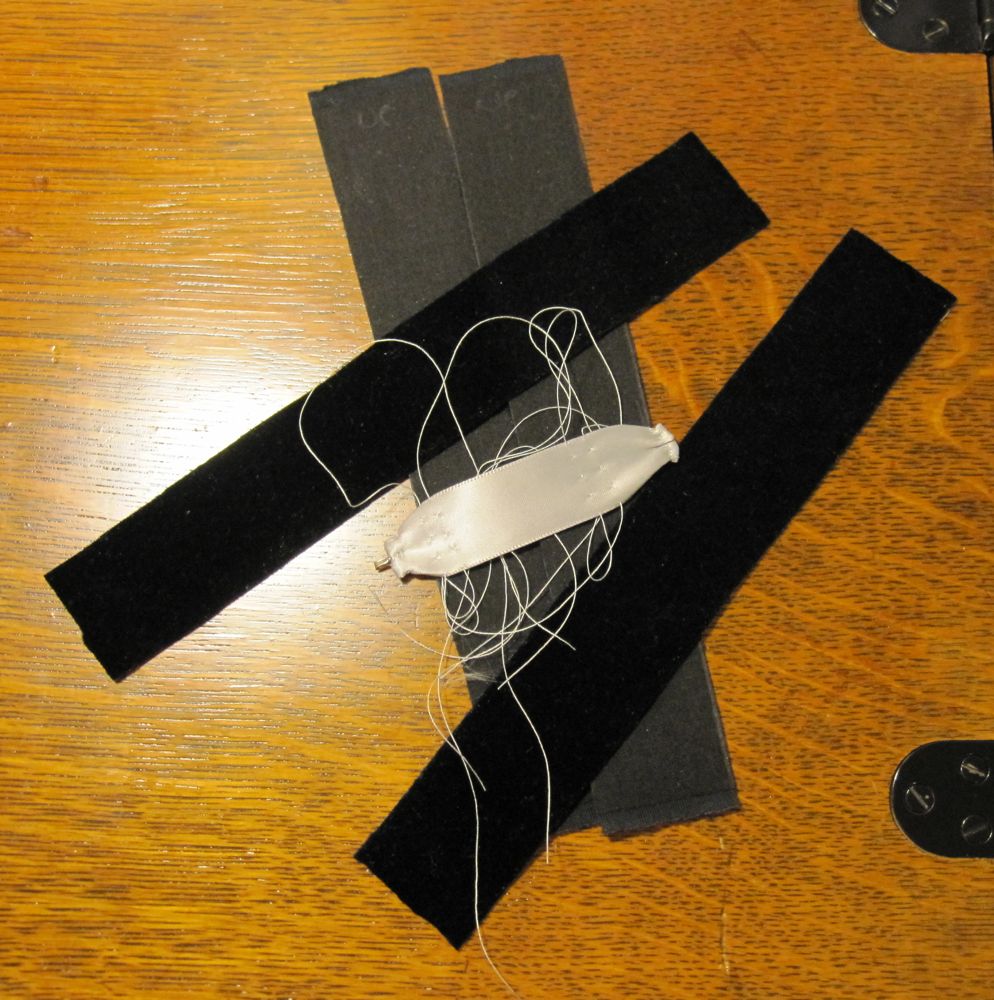
Ooh, velvet and silver. Fancy.


Spring cleaning

Up here in northern New England, spring doesn’t really make its appearance until late April. That means I am not inspired to do spring cleaning until then, but hey, at least it happens eventually (← lying).

This year spring cleaning involved crochet. One of the earliest crochet patterns I downloaded was CRAFT magazine’s reversible Swiffer sock, by Linda Permann. I love the maneuverability of the Swiffer and its ability to get under furniture, but every time I throw out one of the covers I feel like I’m telling the Earth “today, I hate you a little.”

That’s overly dramatic, but I was happy to find a replacement. It cuts the maneuverability down a bit because of its thickness, but works surprisingly well for dusting.


Say hello to my kitchen floor.

The darker one is my first effort. It fits, but is very snug. The Ravelry page for this pattern tells me newer Swiffers are larger than older one, though I think the problem is more likely the fact that I crochet tightly. You can see I’ve already used it; I’m pleased to report it works very well. Both yarns are Red Heart Scratchy Super Saver Special, and I’m pretty sure the bottom color is Cherry Cola. The skein bands are long gone and I have no memory of the top color name. Incidentally, I have no idea why acrylic yarns of the same brand and line vary so much in texture. I have Red Heart Super Saver that’s quite nice to the touch, and other acrylics like Red Heart’s TLC Essentials line also run the gamut.

The pattern is easy, although slip stitching the end of a chain in splitty yarn is obnoxious. It didn’t take much brain, so I was able to do it while on the phone or listening to talk radio.

For my second sock, I switched from an H to an I hook. I haven’t tried it on the Swiffer yet, but it can’t help but fit better.

Finally, while trying to get a picture of the Swiffer in situ (i.e., hanging on the landing of my basement stairs), I knocked over my broom for the last time. I have two brooms now, as I realized my older one had been used outside so much it was no longer very good for indoor use. While the old one has a braided yarn loop for a hanger, the new one had nothing, and its built-in hole wouldn’t go on my hook (at least not easily). Yet a third color of Super Saver came out of the bag.

Instructions: ch 25. Pass ch through hole in broom handle and sl st in first ch to join. Sc around, including in sl st, and sl st in first sc; cut yarn, pull end through sl st, and tie ends of yarn together in a square knot. Trim.

Clearly, you don’t need to chain 25 stitches to get an adequately long loop. It looks like 15 would be ample.